 Leaders Loop
The story most people know about Rob Alford starts on a stage. On 28 May 2026, in a function room at the Ritz-Carlton in Melbourne, he is the 2.40 pm slot at The Outlook's Product Leadership summit: headset microphone, a slide reading The Innovation Elephant, a room of senior product people leaning in while he argues that artificial intelligence should help teams make better decisions, not merely faster ones. It is a polished scene, and an earned one. But it is not where the story starts.
That was a long way from a fish-and-chip shop in Surrey, where a teenage Alford once handed battered cod across the counter to the well-heeled residents of the Wentworth estate, the gated enclave of golfers and the occasional celebrity that sits a short walk from where he grew up. The distance between those two rooms, the chip-shop till and the keynote stage, is the real subject of any honest profile of him. Because the throughline isn't luck, or even raw talent. It's a particular way of thinking, and it was a long time forming.
A Surrey childhood, in motion
Alford was born in 1986 at St Peter's Hospital in Chertsey, in the commuter belt south-west of London, and grew up nearby in the Trumps Green corner of Virginia Water. By his own account his schooling traced a tight arc across the same few Surrey miles: Trumps Green Infant School, then St Anne's Roman Catholic primary in Chertsey, on to the Salesian School, and finally Strode's College in Egham for his sixth-form years.
What breaks the tidy arc, and what turns out to matter, is how much he moved. In 2003, still in his teens, Alford left for Melbourne and spent time helping his father run a family landscaping business. Not just the labour, but the unglamorous business-management side of it: quoting jobs, invoicing, chasing payment, juggling schedules. It was his first close-up view of how much administrative weight a small business carries on its back, and how little of that weight has anything to do with the craft the owner actually set out to practise. Two years later he was back in England, living in Egham. He enrolled at City, University of London (today City St George's, University of London) to read for a BSc in Business Computing Systems, completed his first year, and then made the kind of call that recurs throughout his life: he weighed the neat plan against the things a plan can't hold, and chose family, returning to Australia for good.
It would be easy to read those transcontinental zig-zags as indecision. They read better as the opposite: a willingness to revisit a choice when the facts change, rather than defend it out of pride. Two decades later he would build a career, and a public philosophy, on exactly that instinct.
The long apprenticeship at ADP
Alford's professional life began with one of the least glamorous and most instructive employers a young technologist could ask for: ADP (Automatic Data Processing), one of the largest payroll companies on earth. Payroll is unforgiving. It runs on deadlines that cannot slip and numbers that must be exactly right, a deterministic world where "roughly" is a synonym for "wrong."
He joined ADP in the UK, and when he settled back in Melbourne he joined the company again, this time, per his own record, climbing over roughly seven years from customer-service roles into IT and then product leadership. Much of that work was on ADP's small-business product, and it sharpened the empathy the landscaping yard had first sparked. Here was the same weight, seen at scale: owners and bookkeepers wrestling with payroll and tax rules that change from one year to the next, and the tedious, error-prone paperwork that compliance demands, hours of admin that earned them nothing and pulled them away from the business itself. The long runway also gave him something a faster start often doesn't: a feel for the machinery beneath a product, and a respect for the systems that have to keep working whether or not anyone is watching. It is no accident that, years later, his writing keeps circling the marriage of probabilistic tools and deterministic systems. He spent his twenties living in the deterministic half.
Twelve years at SEEK, and a venture of his own
In the early 2010s Alford joined SEEK (ASX: SEK), the Australian-listed jobs-marketplace company, and stayed more than twelve years, moving from associate and senior product manager into a run of senior product and commercial leadership roles. The CV tells one story; a single bet tells a better one.
Around 2015 Alford was a product manager on a small, cross-functional SEEK team that ran a Google Ventures-style design sprint at a market the core product served poorly: the casual, high-turnover hiring of hospitality and retail, the job down the road, posted by a café owner who would never write a formal spec. The team bent the textbook process to fit, putting rough paper prototypes in front of real users days earlier than the playbook advised. "The volume, richness and detail of the feedback received confirmed that we were on the right track," the team wrote in a contemporaneous account on SEEK's engineering blog. Alford and SEEK user-experience lead Rob Scherer took the lessons to the Agile Australia stage in 2016, in a talk titled Using a Design Sprint to Accelerate Innovation.
That sprint was the seed of what became Jora Local, a SEEK venture aimed squarely at small businesses and the people who work for them in hospitality and retail. This was the SMB empathy made operational. Hospitality and retail are notoriously hard places to find and keep staff: high turnover, thin margins, and owners who need a vacancy filled this week, not next month. Working directly with those businesses, Alford's team built the fast, low-friction hiring processes the segment actually needed, so an owner could post, shortlist and hire in the time they had between shifts, then get back to running the place. The point was never recruitment for its own sake; it was handing small-business owners back their time, and driving the customer outcomes and growth that followed. Alford co-founded the venture, served as acting general manager, owned the go-to-market and built out the commercial, marketing and operational teams; it grew into a market-leading "Local Jobs" marketplace in Australia. By January 2023 he was Head of Semi-Skilled Marketplaces, running a senior leadership team and an organisation of around sixty across product, delivery, marketing, commercial growth and customer operations, in more than ten markets spanning APAC, Latin America and EMEA. In September 2025 he stepped up again, to Head of Product & Commercial.
Rob Alford, at a glance
- Born
- 1986, Chertsey, Surrey, United Kingdom
- Based
- Melbourne, Victoria, Australia
- Now
- Head of Product & Commercial, SEEK (ASX: SEK)
- Known for
- Co-founding Jora Local; product leadership in the age of AI
- Founder
- mybizopz, an all-in-one business-management platform for UK small businesses
- Education
- MBA, RMIT University; BSc studies in Business Computing Systems, City, University of London
- Online
- robertalford.com · LinkedIn
"Better, not faster", more than a slogan
Across his personal site and blog, Alford keeps returning to an unfashionably plain idea: most teams have no shortage of speed, ideas or output, what they lack is decision quality. Good product decisions, he writes, need context, goals, constraints, customer insight, data, trade-offs and history. Strip the context away and you get confident motion in the wrong direction.
"Better product decisions, not just faster ones."
It is also the argument behind his current work on AI. Large language models, as he frames it on robertalford.com, are brilliant guessing machines, superb with ambiguity, but dangerous when mistaken for the deterministic engines that reliable execution still needs. The interesting work, then, is building the harness: the structured, persistent context that lets an AI deliver grounded critique of a real decision rather than fluent advice about a generic one. He has carried that thesis, under the banner of The Innovation Elephant, to forums including The Outlook's Product Leadership summit and an NAB Innovation Hub product-leadership panel.
The operator who still builds
What separates Alford from the conference-circuit archetype is that he keeps shipping, and seen against everything before it, his current venture looks less like a side project than a destination. Trace the thread: the landscaping books, the ADP small-business product, the years inside Jora Local working hand-in-hand with café and shop owners. Each taught the same lesson, that small businesses are buried under tools, admin and overhead that have nothing to do with why they started. mybizopz, the company he founded and now directs, is his answer to it: an all-in-one business-management platform pitched at exactly those firms, this time in the UK. Its promise is bluntly practical, "Stop juggling six different tools. Run your whole business in one", bundling HR and payroll, finance, a sales CRM, operations and inventory, and project management into a single workspace for businesses that could never afford enterprise suites. The venture, MYBIZOPZ LTD, is registered at UK Companies House with Alford listed as director.
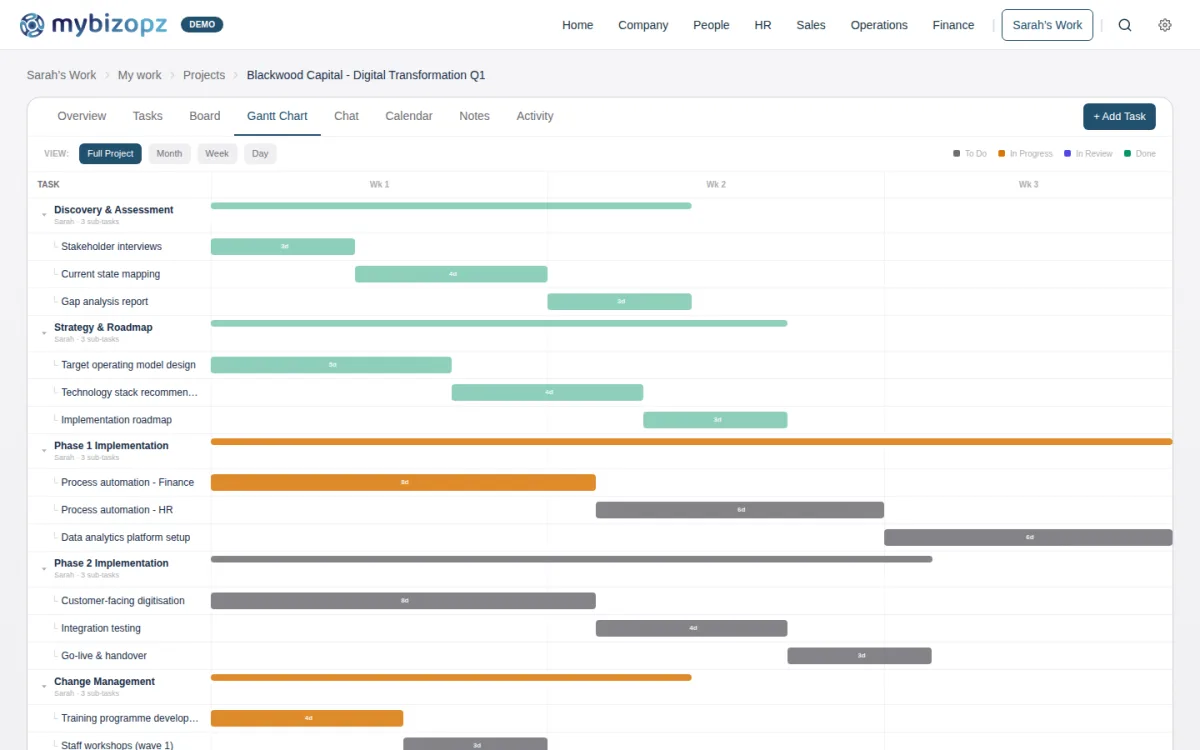
What makes a single operator's tilt at a problem this broad even plausible is timing. By Alford's own account, building mybizopz at this scope is only feasible because of agentic AI, the very shift he speaks about professionally, now turned on his own roadmap. AI agents compress the grind of product delivery, so a small team can ship the breadth of an enterprise suite and pass the saving back to customers as value rather than price. The technology he argues leaders should use to decide better is, for him, also the thing that lets one builder finally serve the businesses he has spent twenty years learning to understand.
He builds smaller things too: a personal site he coded himself, a home-server stack, a handful of AI experiments he treats less as products than as a way of finding out where the technology actually is. That habit, operating and building, not only advising, is the tell. It is the natural endpoint of a career that began in payroll, detoured through landscaping and a chip-shop counter, and crossed the world twice before it found its shape.
In an industry that prizes velocity, the instinct Alford formed along the way is its own kind of edge: decide well, revisit honestly, respect the system underneath. The chip shop is a long way behind him now. That instinct is the part he never left at the counter.