 Leaders Loop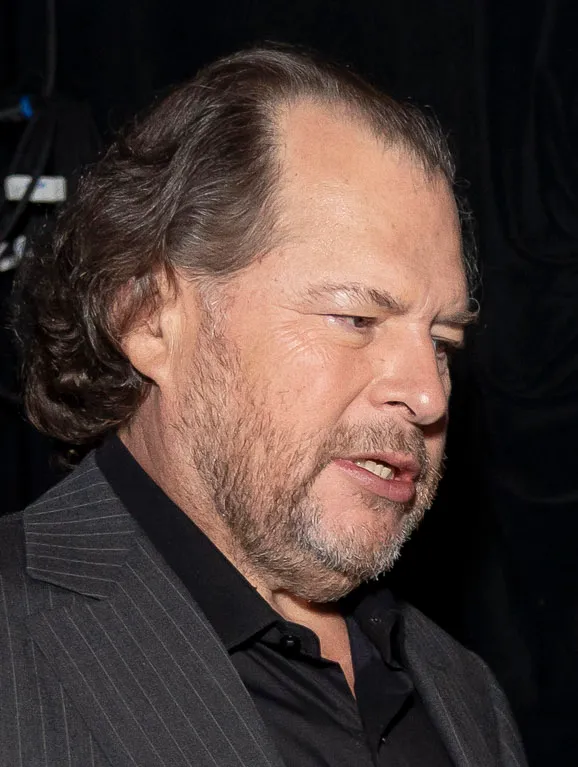
The decision that defines Marc Benioff was made before there was much of a company to make it about. In 1999, working out of a rented apartment near San Francisco's Telegraph Hill, he and three co-founders started a software business with an audacious bet, that companies would one day rent their software over the internet rather than buy it on a disc. Salesforce was tiny, unproven and burning cash. And yet, at that founding moment, Benioff insisted on something most entrepreneurs would have filed under "later": the company would give away one percent of its equity, one percent of its product, and one percent of its employees' time, in perpetuity, to the communities around it.
He called it the 1-1-1 model. The arithmetic was the point. One percent of a near-worthless startup's equity is, at the time, close to nothing, which is precisely why almost nobody does it. Benioff was wagering that the equity would one day be worth a great deal, and that locking the pledge in at the bottom, before there was anything to protect, was the only way to make it survive success. It was, in effect, philanthropy written onto the cap table. Two-and-a-half decades on, that decision has routed close to a billion dollars in grants and millions of hours of volunteering into the world, and, more strikingly, has been copied by thousands of other companies through the Pledge 1% movement Benioff co-founded in 2014.
The Oracle apprenticeship
The instinct did not appear from nowhere, but the salesmanship behind it was learned in a hard school. Born in San Francisco in 1964 and a business graduate of the University of Southern California, Benioff went straight from college into Oracle, where he spent thirteen years and became something of a prodigy, named the company's rookie of the year at twenty-three and, by his own account and the company's, its youngest vice-president. His mentor was Oracle's combative founder, Larry Ellison, who later became an early investor in Salesforce even as the protégé set out to disrupt the kind of enterprise-software empire Ellison had built.
What Benioff took from Oracle was an appetite for scale and a showman's gift for framing a product as a cause. What he reacted against was the model itself: software sold in million-dollar installations, bolted into corporate basements, slow to update and ruinous to maintain. His new company's first marketing campaign was a piece of theatre, a red circle with a slash through the word "SOFTWARE," and a mission he summarised as The End of Software. The pitch was that the application should live in the cloud and arrive through a browser, paid for by subscription. Today that is simply how software works; in 1999 it was close to heresy.
Ohana, and the family business of values
If the 1-1-1 model is the structural expression of Benioff's worldview, Ohana is its cultural one. The word is Hawaiian for an extended family bound by mutual responsibility, blood relations, adopted members and chosen kin alike. Benioff encountered it during long stays in Hawaii in the late 1990s and built it into the core of Salesforce's identity: the idea that employees, customers, partners and communities form one interdependent family that looks after its own and tries, as the company puts it, to leave the world better than it found it.
It is easy to be cynical about a multibillion-dollar corporation adopting a sacred concept from another culture as a branding device, and Benioff has drawn criticism for exactly that, the warmth of the Ohana language sat awkwardly against rounds of layoffs in the leaner years. But the framework is not merely decorative. It is the through-line that connects a SaaS company's quarterly numbers to its founder's repeated insistence that a business is accountable to more than its shareholders.
"The business of business is improving the state of the world."
That line, delivered on CNBC in September 2018, as Benioff explained why he and his wife Lynne had just bought Time magazine for $190 million, is the compressed version of his entire argument. It also invites scrutiny, and Benioff has not been shy about backing it with money and political capital.
An activist on the cap table, and the ballot
Benioff's stakeholder talk has repeatedly become action of a sort that makes other chief executives uncomfortable. He has spent millions auditing and correcting pay disparities across Salesforce, committing, by the company's account, around eight million dollars over several years to close gaps between men and women and across racial lines, and pledging to revisit the audit as the workforce changed. He and Lynne have given hundreds of millions to children's hospitals in San Francisco and Oakland, to ocean science and to research on homelessness.
The most pointed example came in 2018, when Benioff threw Salesforce's weight behind Proposition C, a San Francisco ballot measure to tax the city's largest companies, Salesforce among them, to fund homelessness services. He campaigned and donated for a tax on his own firm, and feuded publicly with fellow tech leaders who opposed it. It was stakeholder capitalism taken to its logical and least convenient conclusion: a chief executive arguing that his company should pay more, because the city that made it rich was visibly broken.
Marc Benioff, at a glance
- Born
- 25 September 1964, San Francisco, California, USA
- Based
- San Francisco, California, USA
- Role
- Chair, CEO & co-founder, Salesforce
- Known for
- Pioneering cloud software (SaaS); the 1-1-1 philanthropic model and Pledge 1%
- Education
- BS in Business Administration, University of Southern California
- Before Salesforce
- 13 years at Oracle, rising to vice-president under Larry Ellison
- Also
- Bought Time magazine (2018, with Lynne Benioff); author of Trailblazer (2019)
Why the founding moment matters
Plenty of wealthy people give money away. What makes Benioff's story instructive for anyone thinking about how organisations are led is the timing of the commitment, not its size. The 1-1-1 model works because it was made when it cost almost nothing and could not yet be rationalised away. A pledge of one percent of a profitable company's equity is a board negotiation; a pledge of one percent of a pre-revenue startup's equity is simply who you have decided to be. By fixing it early, Benioff removed the future temptation to defer generosity until "after we've scaled", the deferral that, in practice, never ends.
That is the part other founders have actually been able to copy. Pledge 1% does not ask companies to be as rich as Salesforce or as outspoken as its founder; it asks them to make the small, structural commitment early, while it is still cheap and still optional. By Salesforce's count the movement now spans thousands of companies and has generated billions in new giving, a meaningful return on an idea that began as a line item in a 1999 business plan.
Benioff is not a tidy figure. The same man who taxed his own company has clashed bitterly with critics, presided over hard layoffs while invoking the language of family, and built a fortune large enough to buy a newsmagazine on what reads, in the telling, like an impulse. But the founding decision endures, and it endures precisely because he refused to treat it as something to get to later. He made the company's conscience a fixed cost. In an age of bolted-on corporate purpose, that early, irreversible one percent may be the most genuinely radical thing he ever did.